Is College Still Worth It?

May 08, 2026
Author
By my senior year of high school, the website I built had caught the attention of Steve Jobs and was later archived in the Smithsonian’s National Museum of American History. The New York Times wrote about it, and the media began referring to me as a “prodigy.”
In my early twenties, I became an executive while many of my peers were still finishing college. By 28, I had started a successful business.
I did all of this without going to college.
Today, my story is often used as evidence that higher education may no longer be necessary. In an era of rising tuition and growing student debt, it fits neatly into a broader narrative that college has become an outdated or overpriced path to success.
But there is a problem with using stories like mine to guide public thinking.
They are the exception.
Statistically, they are outliers, not a reliable plan.
The Growing Skepticism About College
Over the past decade, Americans have become increasingly skeptical about the value of a college degree.
Rising tuition, headlines about student loan debt, and the visibility of successful entrepreneurs who skipped college have fueled doubts. According to data from Pew Research Center, 40% of Americans say a four-year degree is not very important for getting a well-paying job. Political identity has even begun shaping views on the issue.
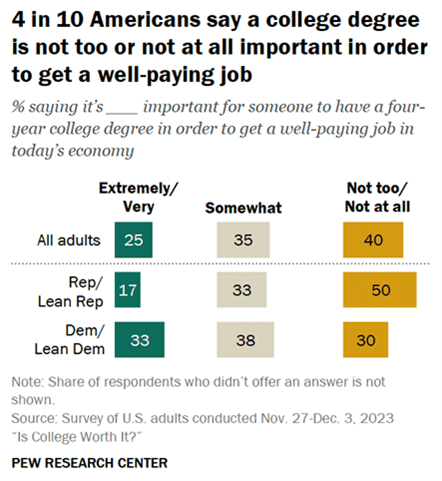
Source: “Is College Worth It?” Pew Research Center, Washington, D.C. (May 23, 2024). https://www.pewresearch.org/social-trends/2024/05/23/is-college-worth-it-2.
These concerns are understandable. For many families, college is the largest financial investment they will make aside from buying a home. It is also a moment of transition, often marked by sending a child far from home for the first time, while students navigate unfamiliar systems, including federal financial aid processes like the FAFSA.
It is reasonable to ask whether the return is still worth it. But when the debate moves from opinion to evidence, a very different story emerges.
The Data Is Clear
Across decades of economic research, the pattern is remarkably consistent. People with college degrees earn more, build greater wealth, and face a lower risk of poverty. They also tend to live longer, experience better health, and participate more actively in civic life, as documented in longitudinal analyses by the National Center for Education Statistics.
A bachelor’s degree is associated with roughly $1.2 million in additional lifetime earnings compared with a high school diploma and about half the risk of unemployment, according to data synthesized by the Georgetown Center on Education and the Workforce and the U.S. Bureau of Labor Statistics.
While wages for workers with only a high school diploma have increased modestly over the past decade, the earnings gap between those with and without postsecondary education remains substantial, according to the Pew Research Center.
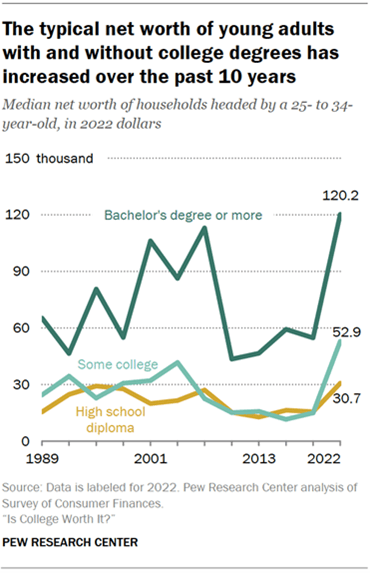
Source: “Is College Worth It?” Pew Research Center, Washington, D.C. (May 23, 2024). https://www.pewresearch.org/social-trends/2024/05/23/labor-market-and-economic-trends-for-young-adults.
Poverty data tells a similar story. Young adults with bachelor’s degrees experience dramatically lower poverty rates than those with only a high school diploma. The same pattern appears in wealth, as households led by young adults with college degrees have significantly higher median net worth than those without one. Across nearly every economic indicator that measures mobility, education beyond high school still matters.
The Labor Market Is Reinforcing the Trend
Even as AI reshapes tasks across the economy, the underlying trend remains the same: Workers with more education and higher-level skills continue to have an advantage.
By 2031, projections from the Georgetown University Center on Education and the Workforce suggest that 42% of jobs will require at least a bachelor’s degree, while only 28% will go to workers with a high school diploma or less.
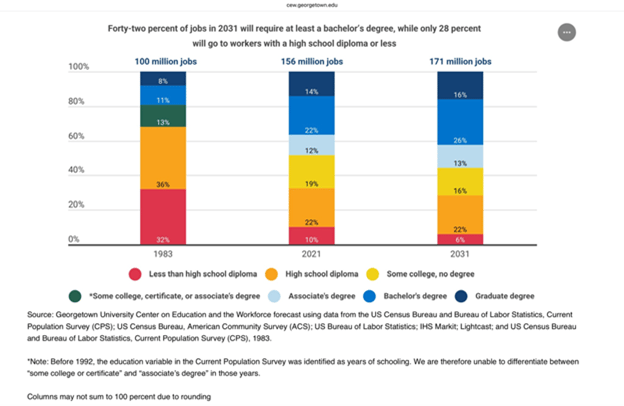
Source: Anthony P. Carnevale, Nicole Smith, Martin Van Der Werf, and Michael C. Quinn. After Everything: Projections of Jobs, Education, and Training Requirements through 2031. Washington, DC: Georgetown University Center on Education and the Workforce, 2023. cew.georgetown.edu/Projections2031.
This does not mean that every student needs a four-year degree. Skilled trades, technical certifications, and other forms of postsecondary training can provide strong and rewarding careers. However, these pathways are not shortcuts. They demand years of rigorous training, the mastery of specialized skills, and sustained effort beyond high school.
But the broader reality remains: The modern economy increasingly rewards education and specialized skills acquired after high school. Workers without access to those opportunities face a much steeper climb toward economic stability.
The Debate Is Asking the Wrong Question
The public conversation about college has become trapped in a false choice: College or no college? That framing is too narrow. The real question is not whether college is worth it. The real question is whether students have the information and guidance they need to make decisions that lead to opportunity, not just aspiration.
Students who understand career pathways are far more likely to complete their degrees—a pattern supported by research on student persistence and completion. Families who understand earnings outcomes can better evaluate which institutions offer the strongest return on investment. And students who receive the right financial support are far more likely to graduate without crippling debt.
When those conditions are in place, the economic value of education after high school becomes far more predictable.
Outliers Should Not Drive Policy
My career path worked out. But it depended on a rare mix of timing, opportunity, and luck.
Public policy and education systems cannot rely on outliers. They must focus on what works for the majority of students.
And the evidence remains clear: Education beyond high school, whether a bachelor’s degree, an associate’s degree, or another form of postsecondary training, remains one of the most reliable pathways to upward mobility.
Public opinion about college may be shifting, but the underlying economics have not. And when it comes to the future of our children, we cannot afford to mistake exceptions for strategy.
Related Articles

The Stories Achievement Data Don’t Tell
Oct 08, 2026

.jpg?auto=webp&quality=75&width=420&disable=upscale "People raising their hands in an indoor event, with one individual holding a microphone and another wearing a light-colored blazer.")