Rethinking Access: A Multilingual Pathway to Calculus
Mar 25, 2026
Author
 AVID Center
With perspectives from Gabriela Whitemarsh, Pasco High School (WA)
At Pasco High School (PHS) in Washington, the push to rethink advanced‑course access began with a pattern math teacher Gabriela Whitemarsh recognized almost immediately upon returning to teach at her former high school. In her first year back, she saw the same gap she had noticed as a student herself: very few bilingual learners were appearing in advanced math classes, even though many of her newcomer and multilingual students were showing strong mathematical promise.
That reality came sharply into focus when one high‑performing student she taught that year was ruled ineligible for a major math award solely because she had never been placed into advanced coursework. That moment, Whitemarsh recalls, “was the straw that broke the camel’s back.”
Instead of accepting the limitation, she built a solution: an Advanced Multilingual Mathematics Program that opens access to advanced mathematics the moment students show readiness. Supported by AVID-aligned strategies and schoolwide professional learning, the program has grown into a model other schools can replicate to expand opportunity and challenge long‑standing assumptions about who belongs in advanced courses.
Data Snapshot
- 126 multilingual newcomer students have now participated in the accelerated pathway
- 61 students have earned 5–20 college math credits
- Prior to the program: only one newcomer had taken any advanced course other than AP Spanish
- PHS serves 179 newcomer students (8.8% of population) and 44% multilingual students
The Big Idea: A Multilingual Accelerated Math Pathway
PHS built a system that identifies multilingual newcomers with math readiness early, places them into a multilingual course sequence, and accelerates them into college‑level math before graduation. The innovation is not simply the courses themselves—but the intentional scaffolds, bilingual instruction, and AVID‑aligned strategies that make rigorous learning accessible without lowering expectations.
The strategy directly supports AVID’s mission: opportunity through access, agency through challenge, and belonging through structures designed to elevate potential.
How Pasco Built a Multilingual, Accelerated, AVID‑Aligned Math Sequence
1. Identifying Talent Early Across a Feeder Pattern
The pathway began with a partnership across schools. PHS collaborated with its feeder middle school’s newcomer team to identify multilingual students with strong math readiness, even if they were still early in their English development.
For the first time, incoming students could take Algebra 1 with a bilingual teacher. This early acceleration mirrored AVID’s call to “open doors as soon as students show readiness,” rather than waiting for conventional language benchmarks.
This shift reframed identification:
- Potential > proficiency
- Readiness > language status
- Opportunity > gatekeeping
2. Designing a Purposeful, Accelerated Sequence
When students reach Pasco High, they enter a targeted math course—Algebra I, Geometry, or Algebra II—based on their prior schooling. Algebra I and Geometry are taught primarily in Spanish, while Algebra II is taught in English with Spanish support. This progression helps students build conceptual strength in their first language while preparing them to succeed in higher‑level math taught in English.
The course sequence is intentionally mapped so students can catch up to, and ultimately match, the advanced math timeline of their peers. For example, students who begin in Algebra I take Geometry and Algebra II simultaneously the following year. It’s demanding, but the structure ensures they can move into Precalculus and then Calculus before graduation.
This alignment removes the years‑long delays that often prevent multilingual students from accessing advanced coursework.
3. Embedding AVID Strategies to Strengthen Language and Rigor
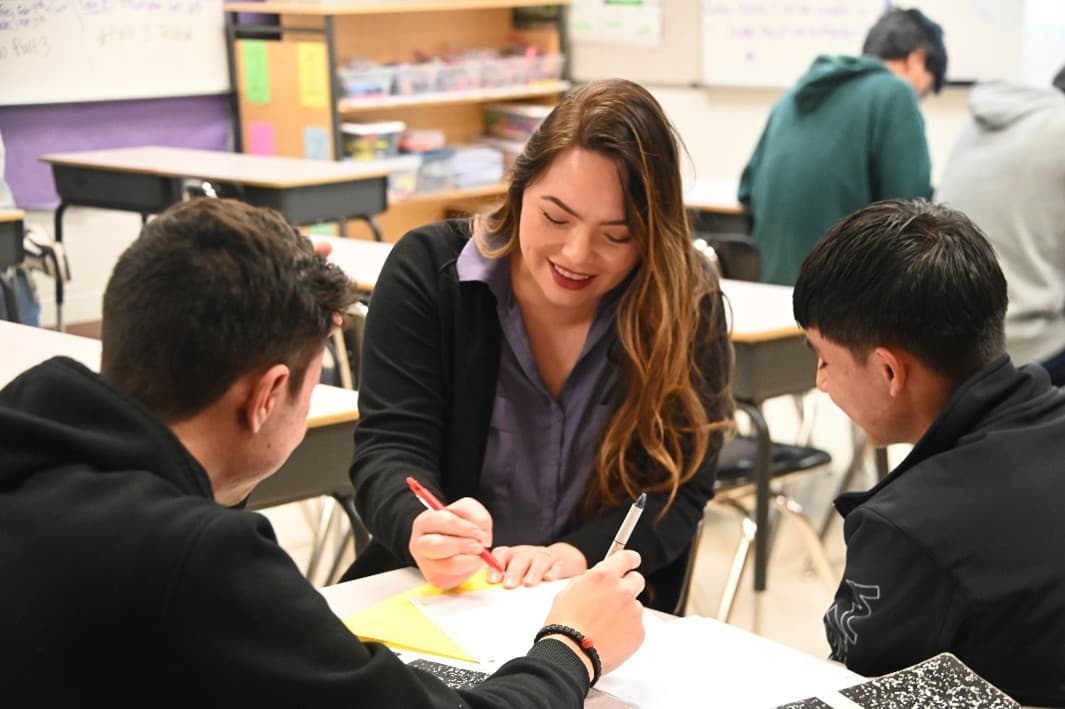
Acceleration alone isn’t enough—students need access to academic vocabulary, problem‑solving language, and collaborative structures. Whitemarsh built a bilingual Precalculus and Calculus class that uses:
- WICOR strategies
- Sentence frames
- Anchor charts
- Structured note‑taking
- Cooperative groups
- Deliberate use of English and Spanish
These routines make rigorous math linguistically accessible. They also reinforce what AVID systems do best: give students tools they can transfer to every class they take.
4. Creating an Alternative Dual‑Credit Pathway
Traditional dual‑credit math courses require students to pass the Accuplacer exam—a challenge for many multilingual learners because the test is administered only in English. As a result, strong math students were routinely under‑placed despite clear evidence of readiness.
Central Washington University already had a system in place to address situations like this: a Memorandum of Understanding that allows students who do not pass the Accuplacer to enroll with instructor permission. Rather than creating a new pathway, Whitemarsh began using this existing option for her multilingual students, submitting the Memorandum of Understanding along with documentation showing they were prepared for the rigor of the course.
Under this agreement, Central also allows her to translate the common final exam, ensuring students can demonstrate true mathematical mastery without their English‑language acquisition limiting their performance.
The shift replaced an English‑dependent gatekeeper with a readiness‑based process—opening dual‑credit access to students whose skills had long been overlooked.
How AVID Professional Learning Sustains the Pathway
A multilingual accelerated pathway requires not only strong course design but a schoolwide instructional culture built around language‑rich, rigorous teaching.
Because multilingual students attend classes across campus, the success of the math pathway depends on every teacher’s ability to support language development. As teachers develop confidence with AVID strategies, they create classrooms that are:
- More linguistically accessible
- More culturally responsive
- More scaffolded
- More focused on student talk and collaboration
- More aligned with rigorous expectations
PHS sustains that culture through intentional AVID‑aligned professional learning.
Starting Each Year Ready
At the beginning of the school year, PHS instructional coaches and the bilingual facilitator offer professional learning that include overlapping strategies including WICOR, GLAD, and SIOP.
Monthly Professional Learning
Once a month throughout the school year, PHS professional learning sessions focus on core components like WICOR and other AVID strategies.
AVID Site Team alignment
PHS’s AVID site team meets monthly to coordinate expectations, refine implementation, and ensure students experience consistent supports across classrooms.
AVID Summer Institute investment
The school sent large groups of certificated staff to AVID Summer Institute for two years, establishing a baseline of shared learning still used today. As budgets have limited travel opportunities, PHS’ commitment to continuous local training preserves this foundation.
Student Impact: Alonzo’s Story
The pathway’s power is best seen through students like Alonzo, who arrived as a newcomer from Mexico—Spanish his second language, English his third, and with interruptions in his schooling.
Quiet at first, he showed exceptional determination. He attended every optional Zoom session during COVID, took Geometry at 6:30 a.m. when others withdrew, and consistently supported peers.
His achievements:
- Ranked 3rd out of 510 students
- Earned 15 college math credits
- Excelled in AP Spanish
- Played JV soccer
- Participated in the prestigious UW Young Executives of Color program
Today, Alonzo is a junior at the University of Washington’s Foster School of Business and recently returned to speak with newcomers at Pasco High.
Evidence of Change: Enrollment, Credit, and Access Boom
Before the program existed, only one newcomer student had taken any advanced course other than AP Spanish.
Today:
- 126 multilingual newcomer students have entered the pathway
- 61 have earned between 5 and 20 college math credits
- Students are now accessing college‑level English, science, and social studies—not just math
- Staff perception of multilingual students’ potential has shifted
- Family engagement and student confidence have strengthened
- The system has more ways to identify potential and fewer ways to overlook it
Put It Into Practice: Map a Multilingual Pathway to Calculus
- Use prior math performance—not English proficiency—to identify multilingual students for acceleration.
- Build a multilingual or scaffolded math sequence that provides a realistic path to Calculus before graduation.
- Partner with feeder schools to identify readiness early and prevent missed opportunities.
- Embed AVID strategies (WICOR, collaborative structures, academic language routines) into every math course.
- Create alternative measures for dual‑credit eligibility when language assessments do not reflect student skill.
- Establish monthly AVID‑aligned professional learning focused on language‑rich instruction.
- Form a cross‑department AVID site team to coordinate expectations and ensure consistency across classrooms.
Pasco High School At-a-Glance
AVID Partner Since: 2022
Total Students: 2,033
- 90.4% Hispanic/Latino
- 6.6% White
- 1.4% Two or more races
- 1% Asian
- .4% Black/African American
English Language Learners 44.4%
Low-Income 77.4%
Students with Disabilities 13.6%
See Pasco High School’s Report Card
For More Information Contact:
Gabriela Whitemarsh, Bilingual Mathematics Teacher, Pasco High School
Related Articles