When Evidence Meets Purpose: How Cassie Freeman Helps AVID Learn What Works
Apr 28, 2026
Author
 AVID Center
Every day in education, decisions are made based on what we believe is working. But at scale, across thousands of schools and millions of students, belief alone isn’t enough. Progress depends on rigorous evidence that can withstand scrutiny, inform policy, and guide real improvement.
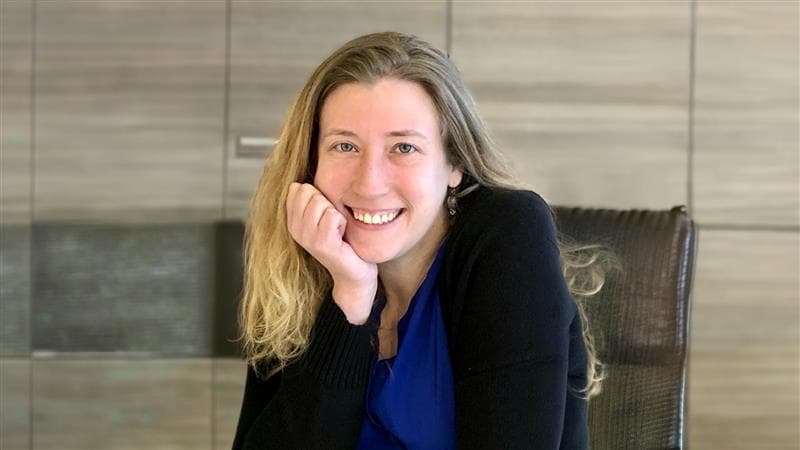
Asking hard questions, building credible measures, and turning complex data into usable insight sits at the center of AVID Center’s Research and Data Team. Leading these efforts is Dr. Cassie Freeman, Vice President of Research and Data, whose career has been defined by one constant: using research to understand not just whether something works but how, for whom, and under what conditions.
Cassie serves on AVID’s Senior Leadership Team, where her role is less about reporting outcomes and more about shaping how the organization learns from its own work.
A Focus on Access and Evidence
Cassie’s experience spans product development, research, and direct engagement with schools and systems, all anchored in a focus on access and evidence. Before joining AVID, she helped build and scale new learning experiences at Duolingo, where she founded the math course, led the Learning Science Lab, and developed strategies to support teaching new subjects on mobile devices. Reflecting on that work, she notes, “Using AI to create learning experiences that impacted millions of learners every day really changes the level of rigor you apply to the work,” underscoring how questions of scale and effectiveness shaped her approach.
Earlier roles brought her into close partnership with districts, educators, and national organizations. At College Board, she worked with systems across the country to expand access to key steps in the college and career pathway, while her time as a Harvard Strategic Data Project Fellow deepened her understanding of how data and policy influence student outcomes in different contexts. In Chicago, she collaborated directly with schools to improve math teaching and learning, supporting educators in using data to inform instructional shifts and studying what it takes to sustain meaningful change. Across these experiences, she has consistently focused on the practical challenges of implementation and how to translate research and strategy into approaches that work in real settings.
Her work also reflects a sustained interest in how people learn and apply knowledge in their everyday lives. Through experiences of teaching statistics to adult learners and developing assessments for early math understanding, she has emphasized relevance, usability, and access. Recalling her work at Duolingo, she says, “we interviewed learners to build empathy but also built novel ways of measuring learning,” highlighting a dual focus on human experience and rigorous evaluation. That same orientation carries into her current role at AVID, where she draws on her background in research, data, and large-scale product development to design tools and strategies that support effective implementation and expand opportunity for students.
Why AVID
Cassie joined AVID Center a year and a half ago, drawn by both the organization’s mission and its track record.
“As an education researcher, I knew about the evidence behind AVID’s impact, and I had seen AVID in classrooms,” she says. “I was excited to work at an organization that impacted the lives of so many students and teachers.”
Today, her work spans research design, implementation measurement, and continuous improvement. She also brings an external lens. Cassie currently serves as an expert adviser to the U.S. Department of Education’s Federal Student Aid office, advising on how data can be used to make student aid—like that offered through the Free Application for Federal Student Aid (FAFSA)—more accessible to students who need it most.
Making Data Useful for the Work That Matters
At AVID, Cassie leads teams responsible for ensuring that programs are effective and improving over time. This means building systems that help the organization learn from its own work, not just describe it.
Her approach emphasizes:
- Measuring not only outcomes but implementation
- Understanding variation across contexts
- Using data as a tool for inquiry, never judgment
Rather than allowing data to live only in dashboards or reports, Cassie’s teams focus on translating evidence into insight that informs program design, partner conversations, and strategic decisions.
Try This: Let Data Ask Better Questions
Take inspiration from Cassie’s work and perspective: Use data as a starting point to ask more questions.
- Look for patterns.
- Document your hypotheses.
- Test your hypotheses.
- Learn and adjust.
At AVID, that mindset ensures the organization’s growth is responsible, responsive, and focused on what matters most: expanding opportunity for students through practices that are proven.
Behind every meaningful insight is someone willing to ask careful questions and follow the evidence. At AVID, Dr. Cassie Freeman helps make that learning possible.
Related Articles


The Power of Shared Leadership
Sep 24, 2026