Open Middle
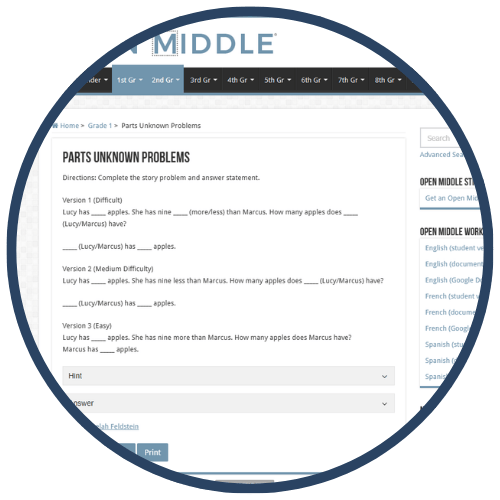
Open Middle is a math problem‑solving approach and digital resource that presents problems with a fixed beginning and end, but multiple valid solution paths. Hosted at OpenMiddle.com and developed by math educator Robert Kaplinsky, Open Middle tasks are designed to promote flexible thinking, number sense, reasoning, and mathematical discourse. Teachers use Open Middle problems to shift instruction away from answer‑getting and toward sense‑making, justification, and conceptual understanding.
Tech Level

Easy
Grade Bands
3-12
Explore the Tool
Getting Started
Visit https://www.openmiddle.com/ and browse tasks by grade level or topic.
Select a problem with a fixed beginning and end value.
Present the task digitally (projected or shared) or in print.
Allow students time to explore multiple solution paths before sharing.
Key Classroom Features
Fixed Start, Fixed End: All students begin and end with the same constraints, but solve differently.
Multiple Entry Points: Tasks support differentiation without modifying the problem.
Discourse‑Ready: Problems are intentionally designed to spark discussion, comparison, and justification.
AVID Strategy Connections
✏️ Writing
Mathematical Explanations: Students write justifications explaining why their solution works.
Reflection Prompts: Learners reflect on how their strategy differed from peers’ approaches.
💡 Inquiry
What if…?” Questions: Students ask how changing a single value affects the solution path.
Strategy Analysis: Learners investigate which methods are most efficient and why.
💬 Collaboration
Turn and Talk: Students compare strategies with partners before a whole‑class discussion.
Gallery Walks: Multiple solutions are displayed and discussed without ranking correctness.
🗂️ Organization
Strategy Sorting: Students organize solutions by type (e.g., additive, multiplicative, visual).
Error Analysis: Learners examine partial or incorrect solutions to identify gaps in reasoning.
📖 Reading
Problem Deconstruction: Students closely read constraints and interpret mathematical language.
Visual Reading: Diagrams, number models, and representations are analyzed as “texts.”
Accessibility Spotlight
Open Middle supports inclusive mathematics instruction by offering low‑floor, high‑ceiling tasks that allow all students to engage meaningfully in the same problem. Because there is no single prescribed method, students can use visual models, manipulatives, number sense, or symbolic reasoning to demonstrate understanding. This flexibility benefits multilingual learners, students with processing differences, and those who struggle with traditional algorithm‑first instruction, while still maintaining high cognitive demand and rigor.